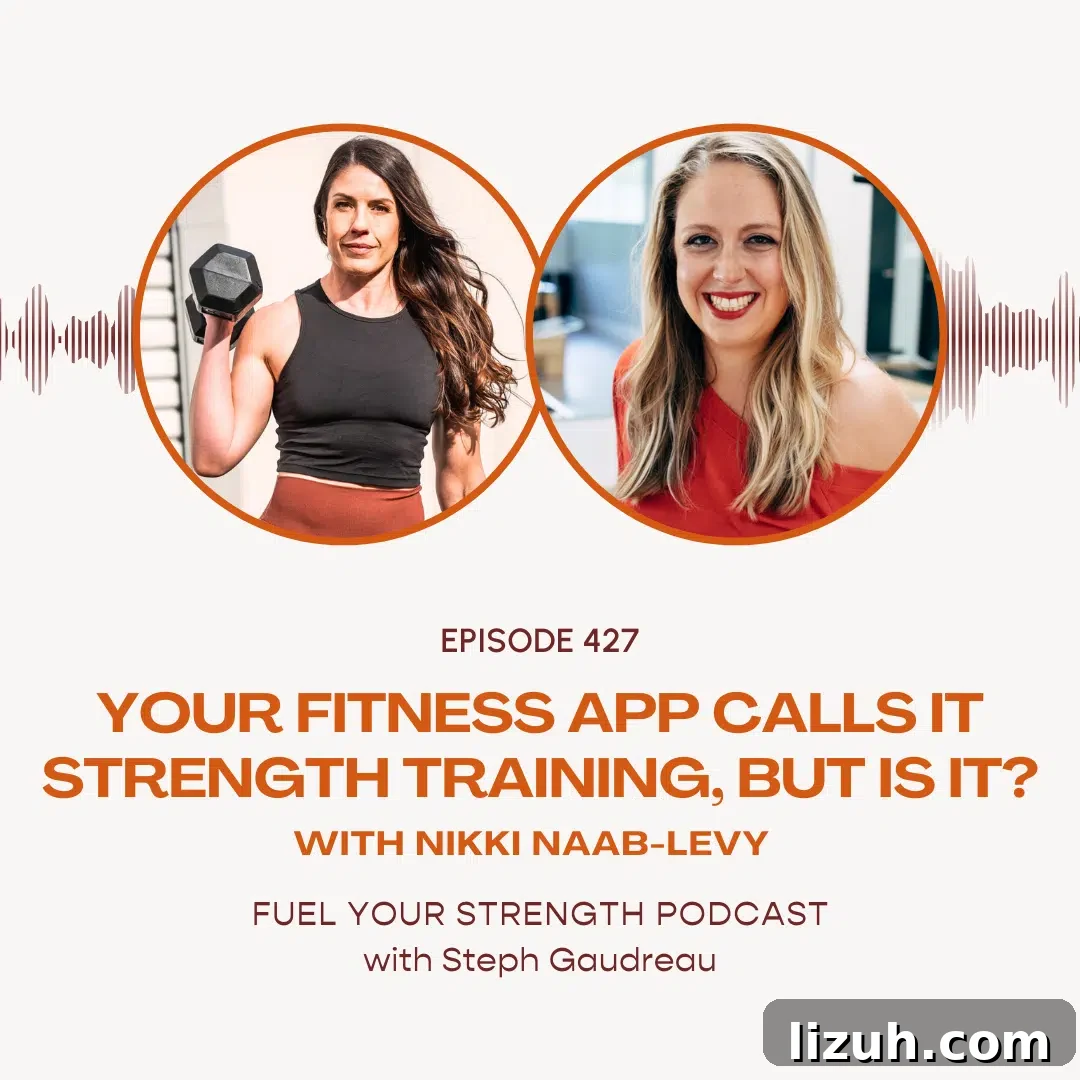
If you’re reading this, you probably already know that strength training is an essential part of caring for your body as you age. With so many apps and YouTube programs labeled “strength,” it’s easy to assume these workouts will build real strength. But are they actually delivering a true strength stimulus—or just good marketing?
Listen right on this page without an app:
Or listen on your preferred platform: iTunes (Apple Podcasts) | Spotify | YouTube
Get a free week of strength workouts: Click here to get started
Key Takeaways
If you want to take programming seriously, do these three things:
- Start from where you are—no shame, no judgment.
- Learn the differences between true strength programming and other formats so you can evaluate what you’re being offered.
- Work with a coach who understands your goals and how to help you progress safely.
Behind the Scenes with Nikki Naab-Levy
Nikki Naab-Levy is a strength and nutrition coach with 17 years in the fitness industry. She helps women improve movement, build strength, restore mobility, recover from injury, and find sustainable nutrition approaches. Nikki is passionate about honest conversations that challenge misleading fitness marketing and help women pursue stronger, healthier bodies.
Understanding the Nuance
How can you tell if the workouts in your favorite fitness app are true strength training or simply follow-along classes that feel like exercise? In many cases, you can’t—unless you understand the underlying programming. Marketing often blurs the line between muscular endurance, circuit training, and genuine strength work. Learning how programs are structured helps you choose one aligned with your goals.
It’s Not You—It’s Your Workout
Doing workouts that aren’t suited to your needs can leave you chronically sore, injured, exhausted, or stuck with little progress. That doesn’t mean you lack effort; it means the programming may be mismatched. The difference between random workouts and intentional training is that good programming acknowledges your weak points, respects your recovery needs, and gives you a clear, sensible path forward. While apps and videos can help, long-term progress is difficult without a program designed for your goals.
How do you interact with fitness apps? Share your experiences in the comments.
In This Episode
- What separates strength programs from circuit training and muscular endurance work (11:54)
- How to evaluate programming available on popular apps (31:22)
- Creating long-term plans that go beyond short-term fads (43:45)
- The role of repetition and practice in successful training (49:54)
- Why preparation and progression matter before jumping into advanced movements (1:04:12)
Notable Quotes
“We’re not hating on the workouts. We want you to make an informed decision so you pick an approach that actually works for your goals without constant frustration or joint pain.” (8:00)
“If you can do high-quality work with appropriate weight and rest, you’ll get results without being ridiculously sore.” (41:56)
“How programs are put together makes a huge difference, especially over the long term.” (42:50)
“Programming can be broad or highly specific, but there should always be logic behind it.” (54:17)
“Give yourself the tools to be successful. If something isn’t working, you likely need a different or scaled approach—not a personal failing.” (1:08:44)
Featured on the Show
Apply for Strength Nutrition Unlocked
Nikki Naab-Levy Website
Follow Nikki on Instagram
Total Package Strength
Follow Steph on social media and subscribe to the podcast.
Related Episodes
FYS 373: The Problem with Tiny Pink Dumbbells with Nikki Naab-Levy
FYS 358: Hypermobility and Strength Training with Nikki Naab-Levy
Transcript Excerpt: Your Fitness App Calls it Strength Training, But Is It?
Steph Gaudreau
You get motivated and open your favorite fitness app looking for a workout labeled “strength.” But will that session actually build strength? Today I’m joined by Nikki Naab-Levy to dig into how to tell the difference between programs that truly develop strength and those that mainly build endurance or provide cardio-style conditioning.
Steph Gaudreau
I’m a strength nutrition strategist and weightlifting coach. This podcast focuses on evidence-based strategies for nutrition, training, and recovery—especially important as we move through our 40s and beyond. If you want to build strength and muscle while improving energy and performance, subscribe.
Steph Gaudreau
Welcome back to the podcast. I’m excited to have Nikki on—she specializes in working with folks who have hypermobility and offers very practical coaching. Today we’ll explore how many popular follow-along programs are marketed as strength training but are often structured as circuit work with short rests, high reps, and arbitrary weight choices.
Nikki Naab-Levy
We often hear people say “I tried strength training and it didn’t work for me” but digging deeper reveals they were doing high-rep follow-along classes that prioritize volume and endurance, not the progressive loading and rest needed to build strength, muscle, and bone. Those classes aren’t bad—many people enjoy them—but they’re not always appropriate for specific strength goals, and they can be especially problematic for people with sensitive systems or chronic conditions.
Steph Gaudreau
Programs that use time-based circuits (e.g., 45 seconds on, 15 seconds off) encourage high-rep, low-rest work. That structure makes it impossible to lift heavy enough to recruit the muscle fibers necessary for true maximal strength development. You can get muscular endurance and conditioning from those workouts, but not the same adaptations you get from properly loaded sets with adequate rest.
Nikki Naab-Levy
High volume and novelty—lots of different exercises with many repetitions—can cause disproportionate soreness and poor recovery, especially in hypermobile or sensitive individuals. A safer, more effective approach often looks like fewer exercises, fewer reps per set, gradually increasing load, and planned deloads to prepare tissues and the nervous system to handle heavier work without chronic pain.
Steph Gaudreau
Apps and classes frequently recommend a single weight for many different movements, leaving participants under-loaded for compound lifts or overloading isolation moves with momentum. They also lack clear progression beyond a four- to eight-week window. For long-term gains, you need repetition, consistent practice, and a plan that progressively increases challenge in a controlled way.
Nikki Naab-Levy
Repetition isn’t boring—it’s the foundation of adaptation. Repeating movements allows gradual increases in load and skill, which protects against excessive soreness and injury. At the same time, you can introduce novelty thoughtfully, but not so frequently that you prevent meaningful adaptations.
Steph Gaudreau
If you’re ready to get serious about strength, consider programming that balances structure and flexibility: a consistent base that enables progression, with room to personalize exercises and accommodate life’s demands. For many people, even two well-designed 30- to 45-minute strength sessions per week will outperform random, high-volume classes in terms of long-term progress.
Nikki Naab-Levy
If a program leaves you constantly sore, tired, or injured, it’s not a personal failing. It’s a sign the programming or progression needs to be adjusted. Give yourself the tools to succeed—seek coaching, start conservatively when needed, and allow practice and repetition to build real strength safely.
Steph Gaudreau
If you’re an athletic woman over 40 looking to improve strength, muscle, and bone health, check out Strong With Steph—my 12-month progressive strength plan built for this life stage. You can sample a week of the program at StephGaudreau.com/workout. If you’re living with hypermobility, check out Nikki’s Total Package Strength.
Steph Gaudreau
Thanks for joining us—stay strong.