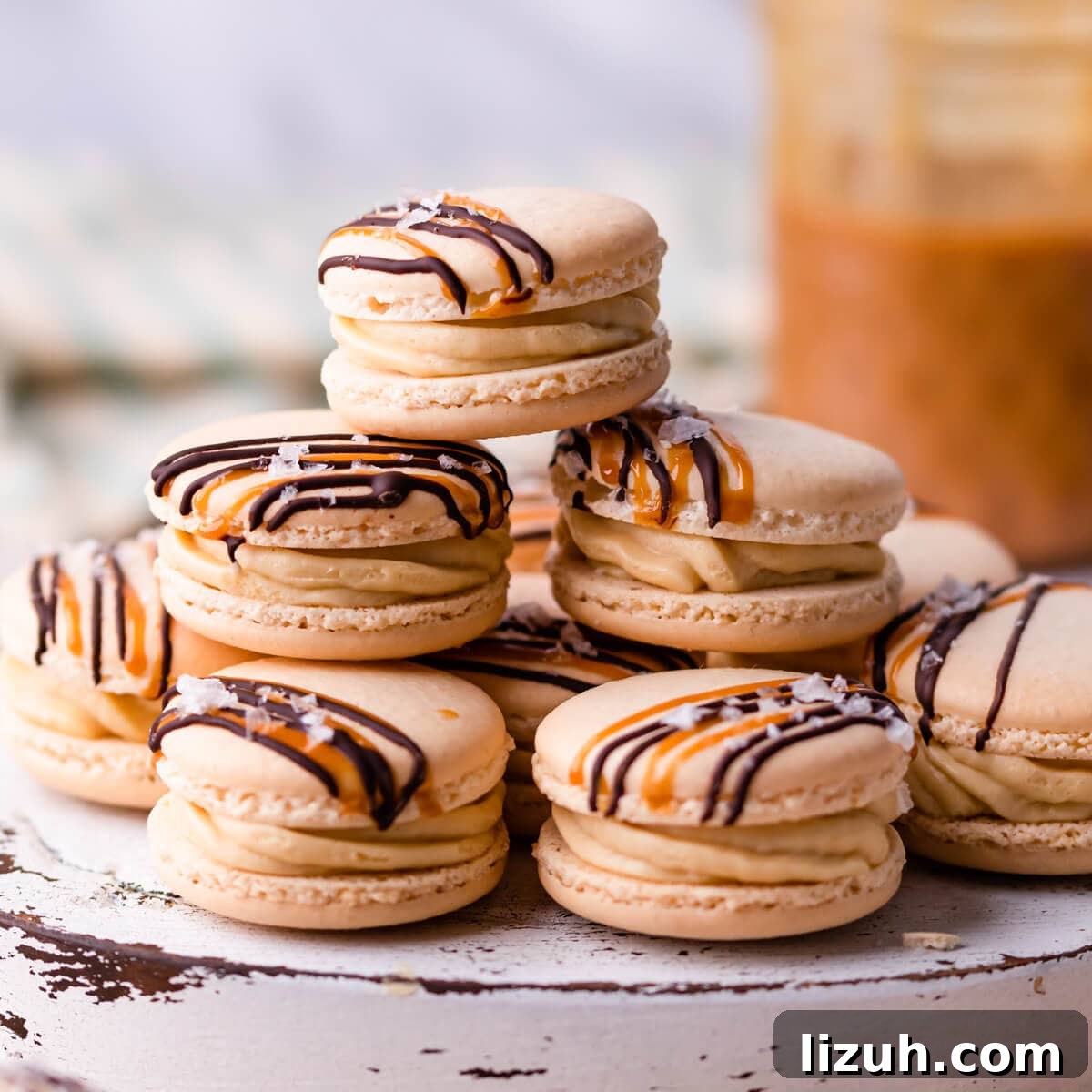
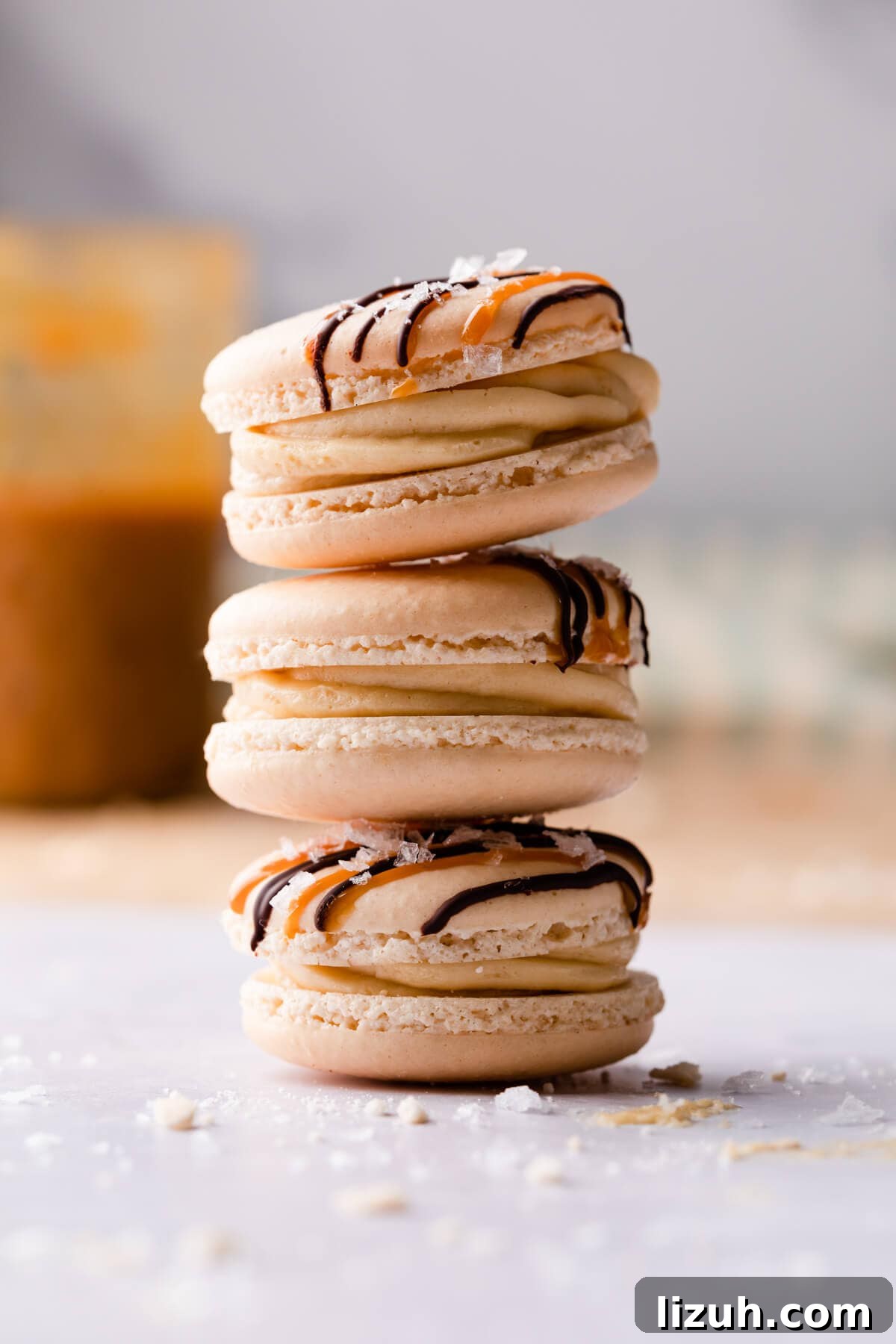
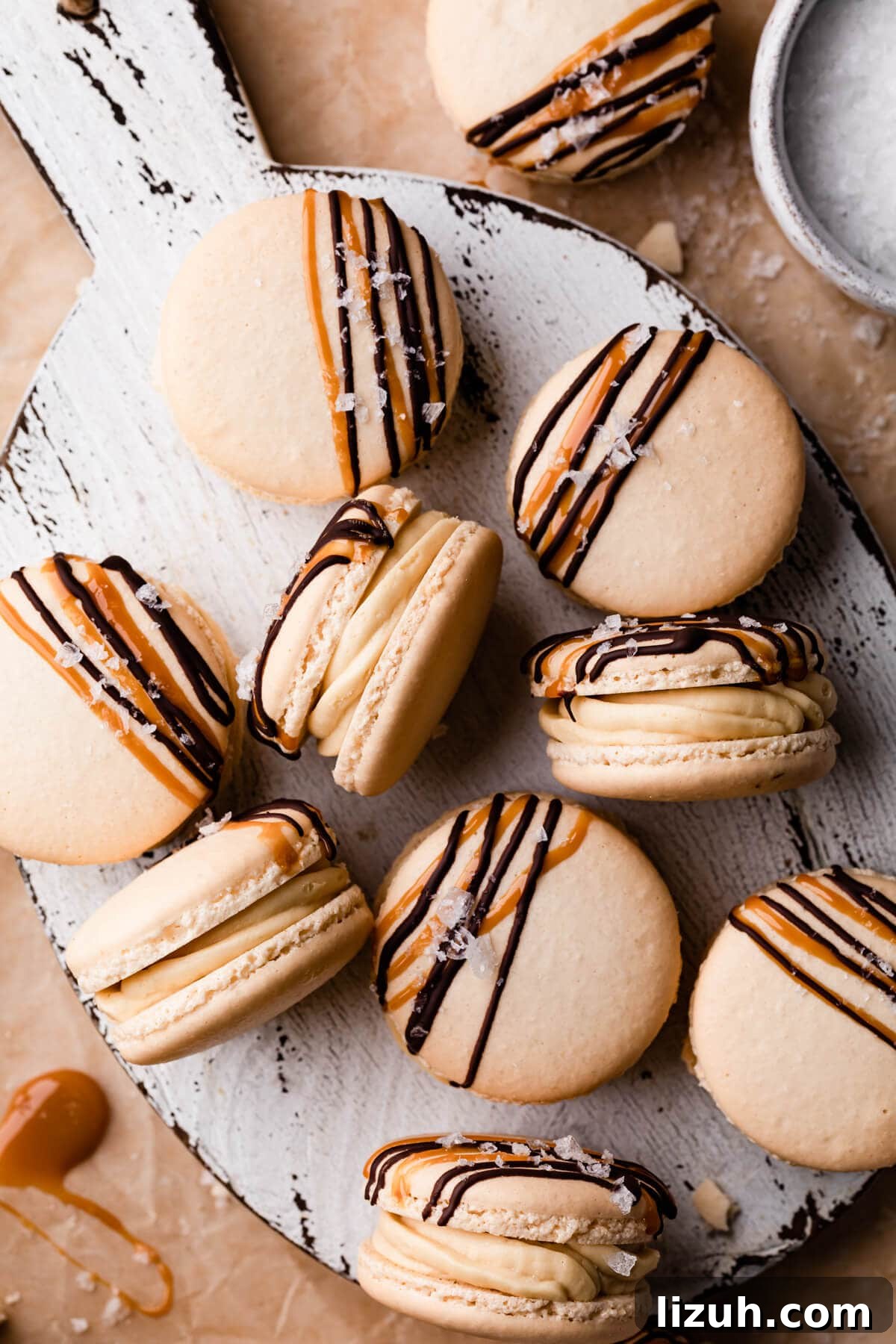
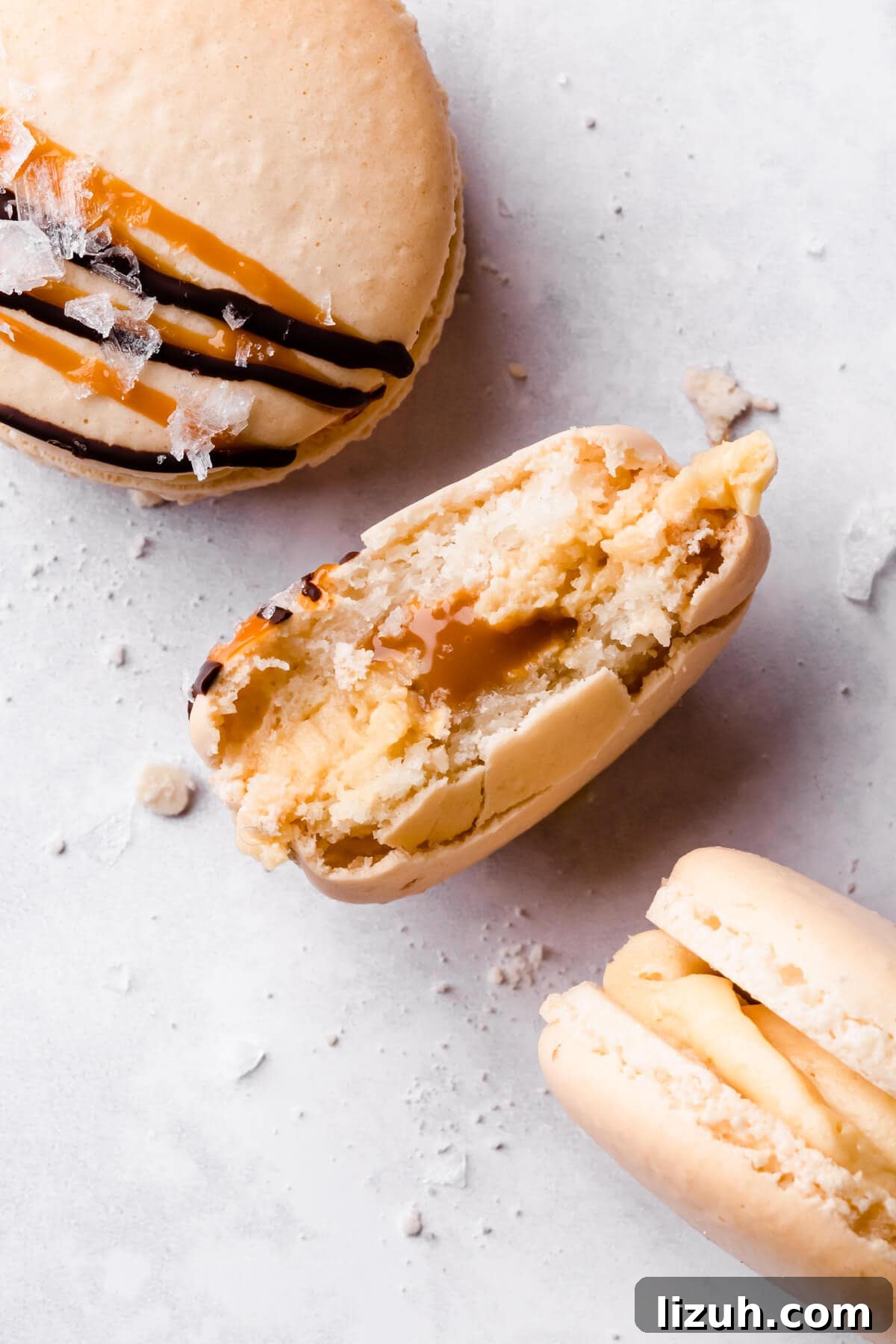
Homemade salted caramel macarons are an elegant, irresistible treat made of crisp French macaron shells filled with a salted caramel Swiss meringue buttercream and a gooey center of salted caramel. Each macaron is finished with a drizzle of caramel and chocolate and a sprinkle of sea salt flakes for the perfect balance of sweet and salty.
With a crunchy exterior and a soft, chewy interior, these macarons are filled with creamy buttercream and caramel—delicious from the first bite.
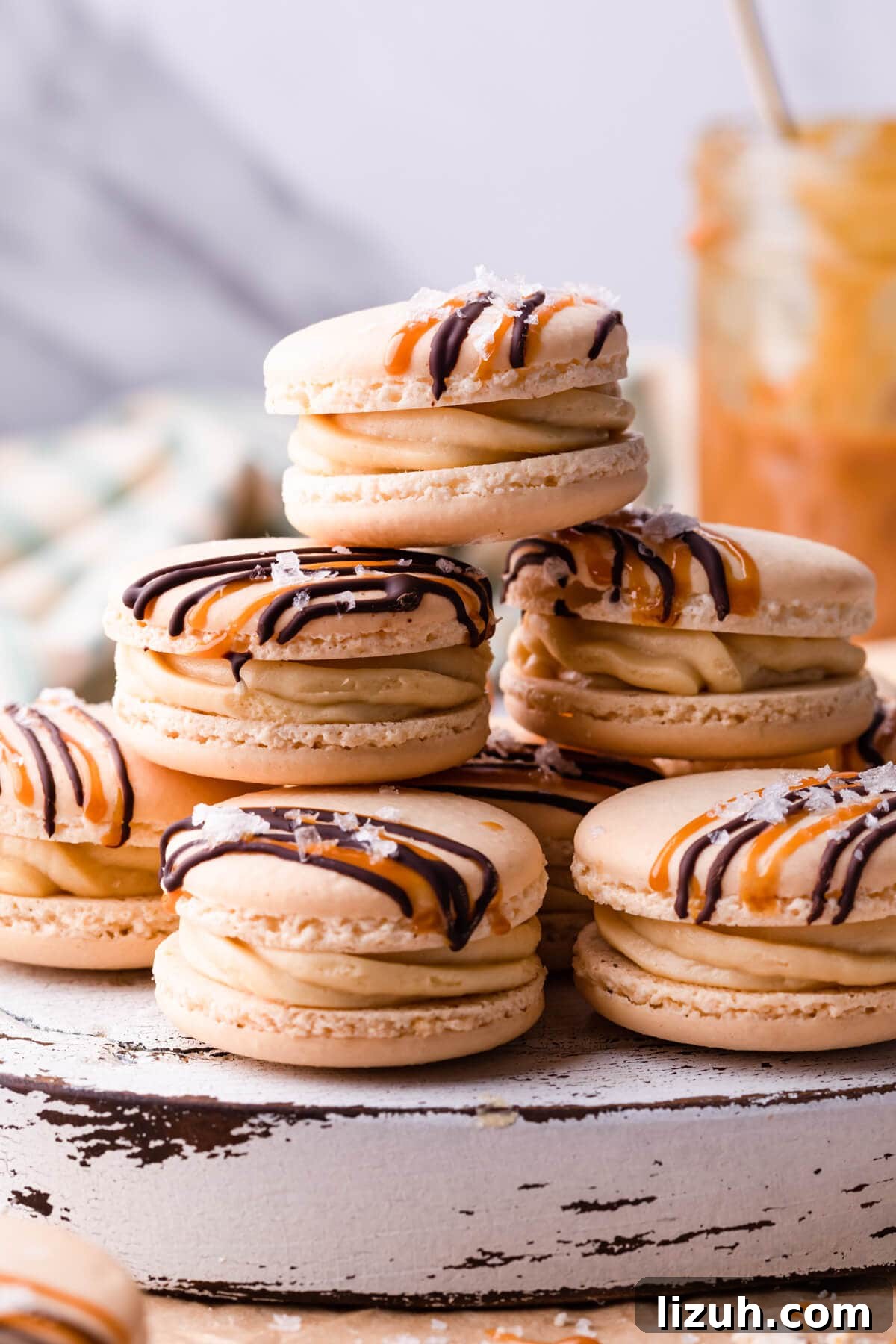
Macarons are perfect for any occasion and make lovely gifts during the holidays. They look beautiful on a dessert table and taste even better than they look.
For more edible gift ideas, try Danish Butter Cookies, Lemon and Pistachio Biscotti, or Dulce de Leche Stuffed Cookies—each a thoughtful homemade present.
Ingredients
For the macaron shells:
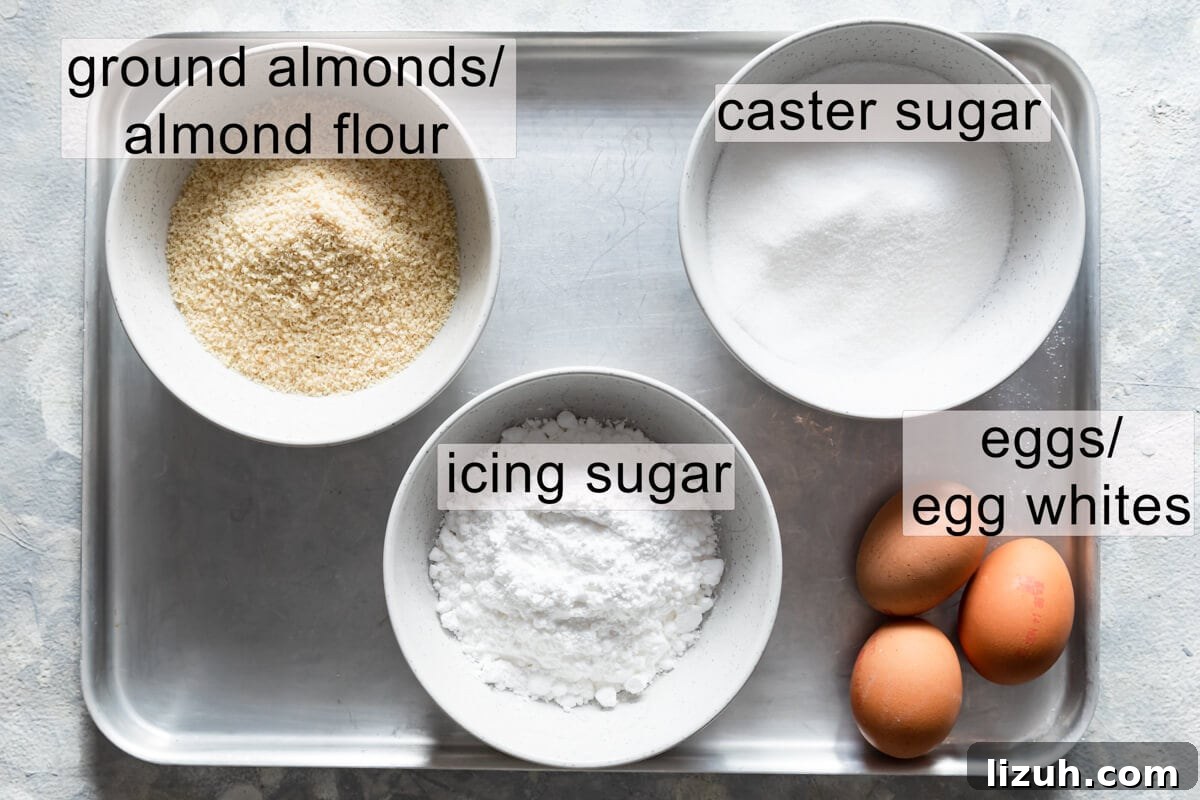
- Egg whites — room temperature.
- Sugar — caster or granulated sugar to stabilise the meringue.
- Ground almonds or almond flour — gives the macarons their texture.
- Icing (powdered) sugar — helps create the classic macaron “feet.”
For the salted caramel Swiss meringue buttercream:
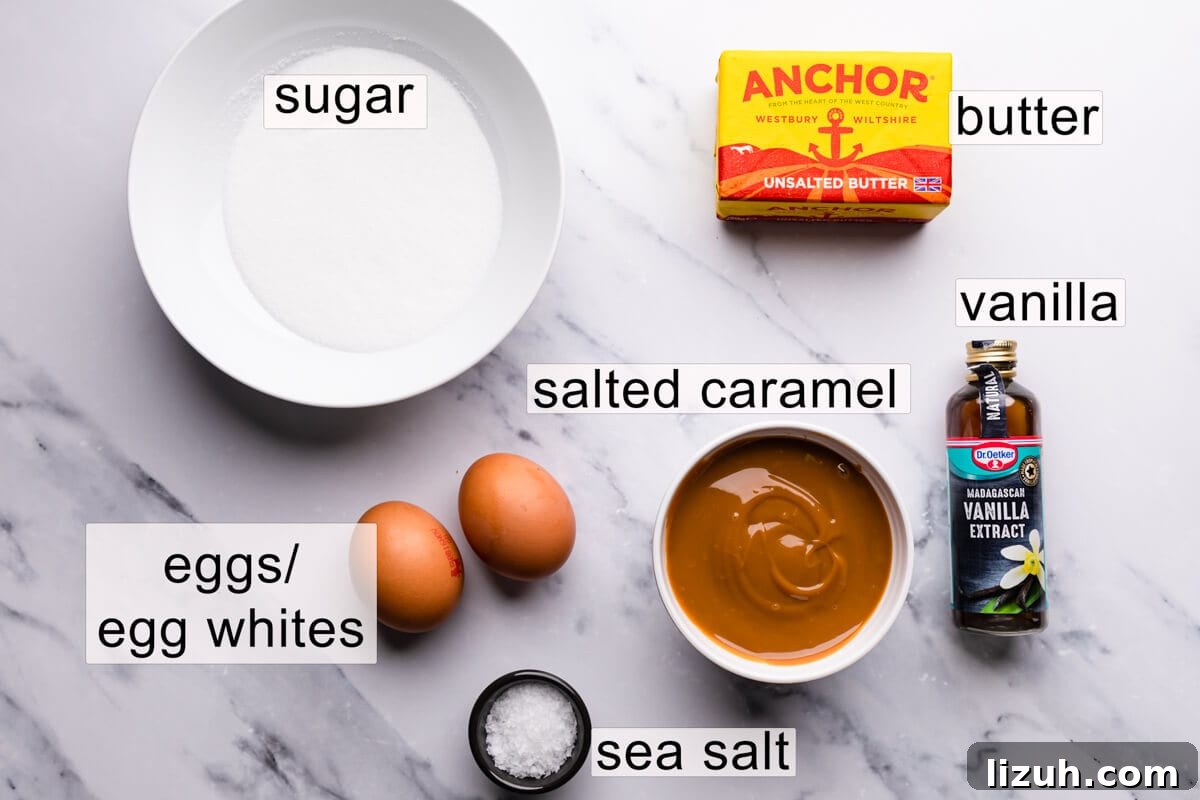
- Egg whites.
- Sugar.
- Butter.
- Salted caramel.
- Vanilla extract.
- Salt.
Scroll to the recipe card below for exact measurements and the full ingredient list.
Instructions
Watch the recipe video if you can before starting — it makes the technique much clearer.
I usually make the buttercream first, but you can work in whichever order suits you. Macarons can seem fussy, but with practice the process becomes straightforward and repeatable.
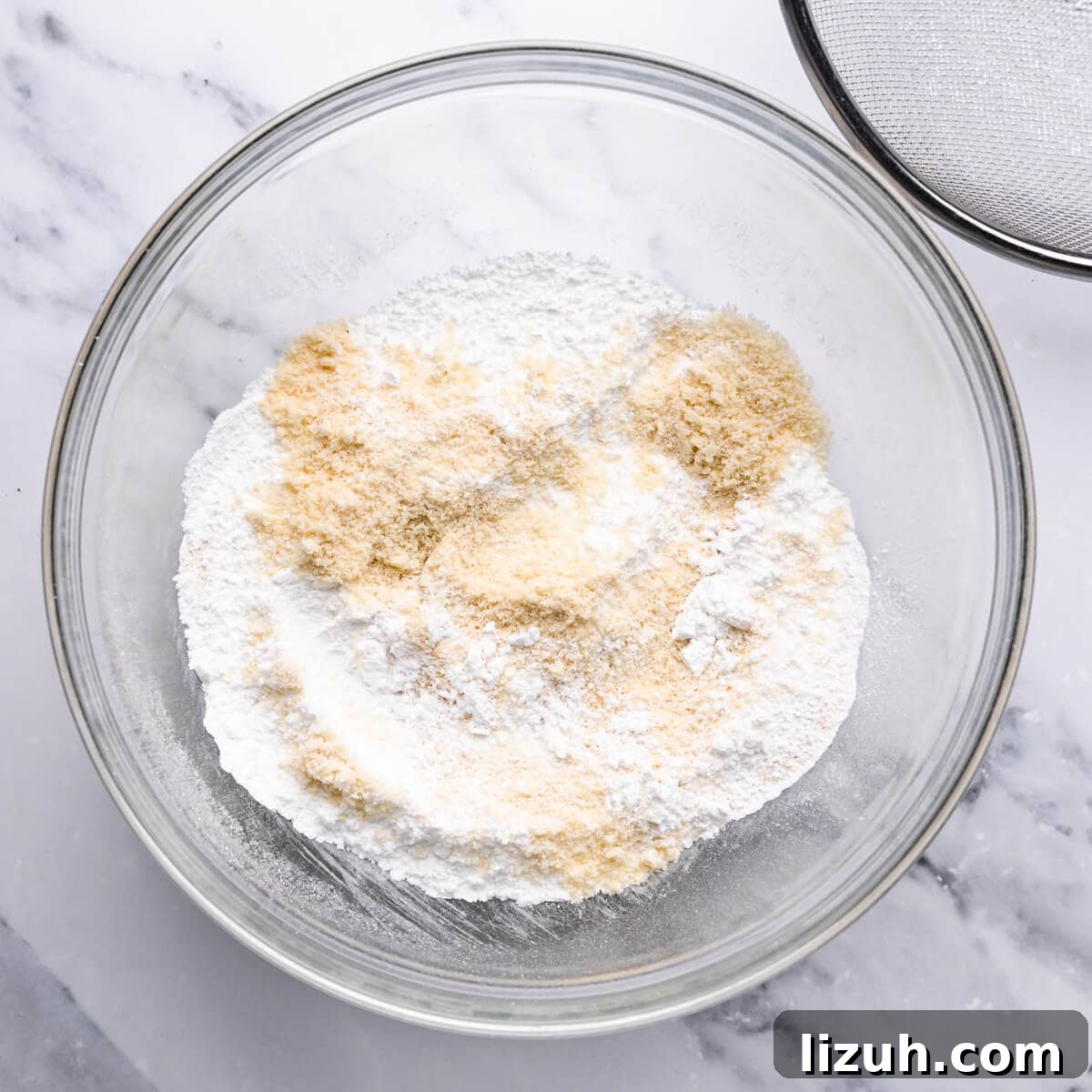
Sift almond flour (or ground almonds) and icing sugar together. Use a sieve to remove any large particles—sifting twice helps achieve a very fine texture and smooth shells.
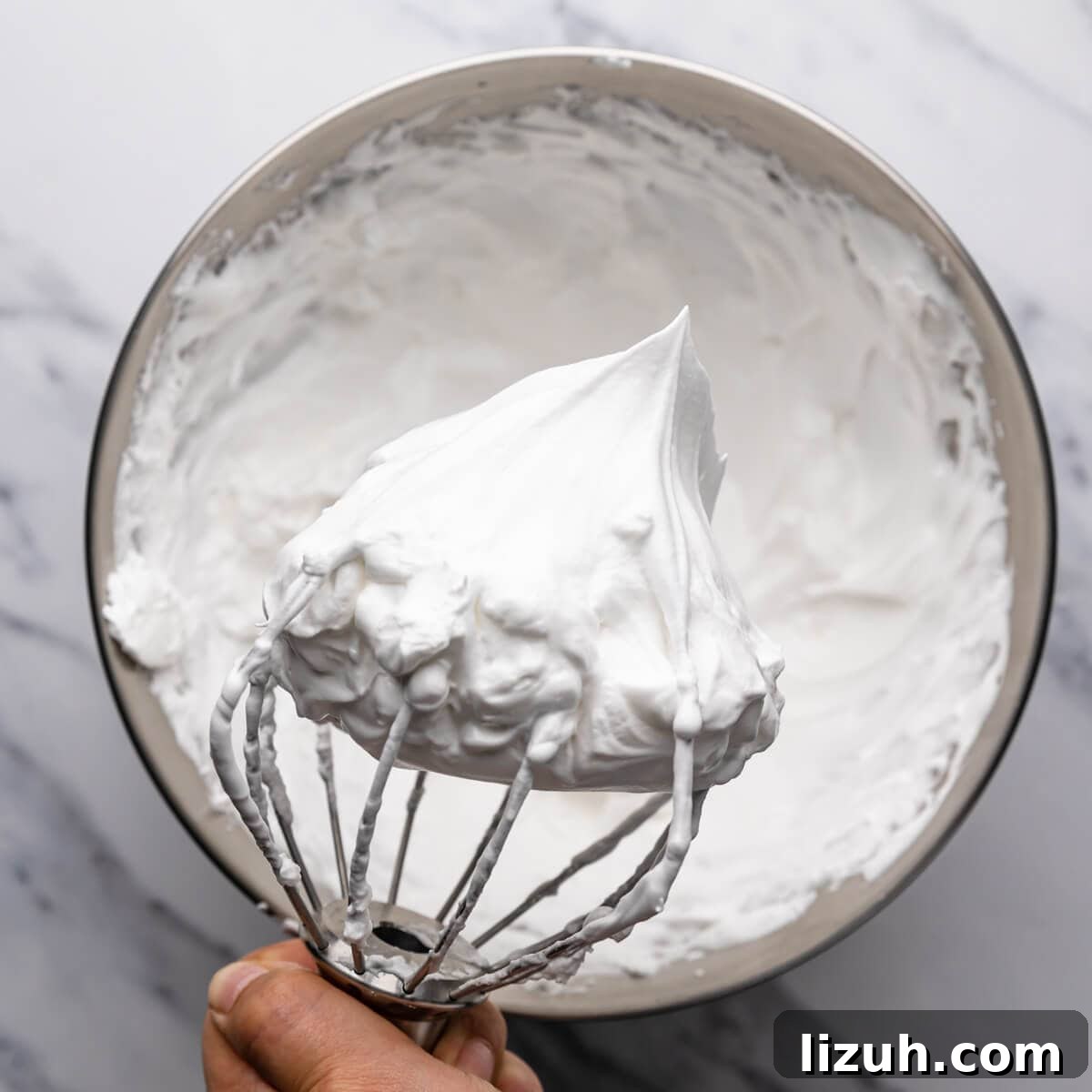
Whip the egg whites to soft peaks, then gradually add sugar and beat to stiff peaks. Gently fold in the almond/powdered sugar mixture until the batter is glossy and flows in thick ribbons.
Hint: Use a fine sieve to catch any larger almond particles. Sift twice if necessary to avoid gritty shells.
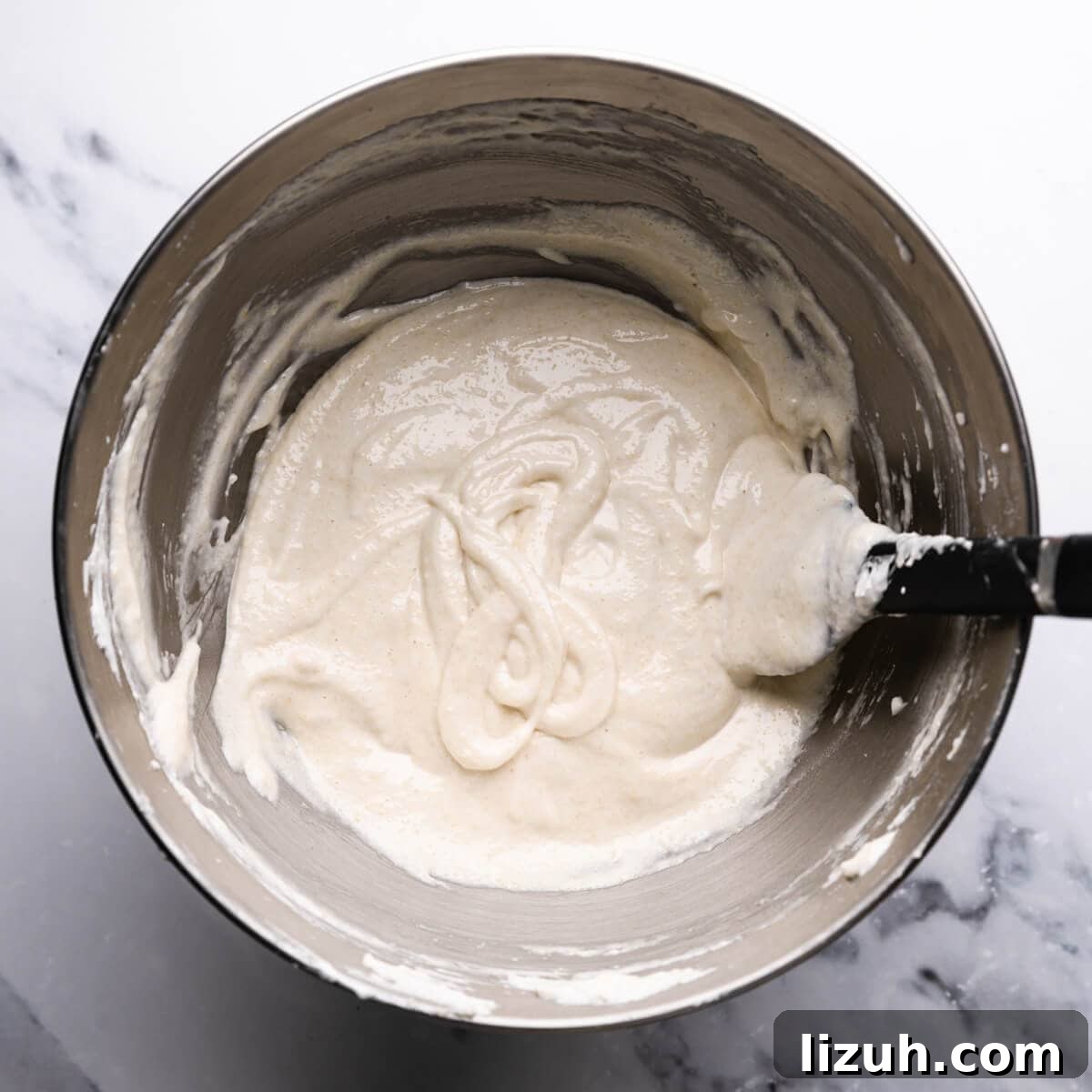
Fold the batter until it falls in a thick ribbon and you can draw a figure 8 without the batter breaking. Transfer the batter into a piping bag and pipe uniform rounds onto lined baking sheets. Tap the trays to release air bubbles and pop any that appear.
Let the piped shells rest until they form a dry “skin” on the surface; drying time depends on humidity and can range from 30 minutes to a few hours.
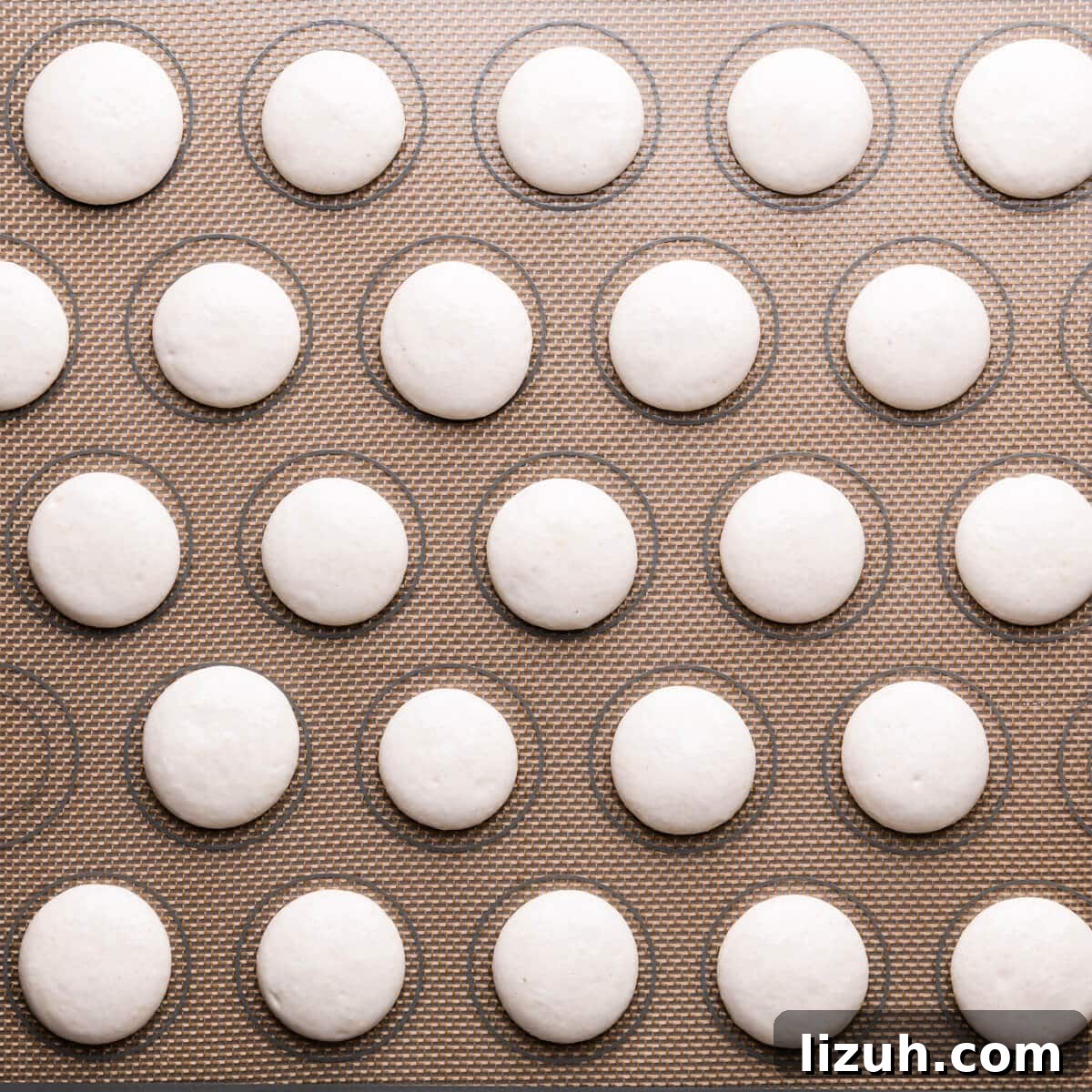
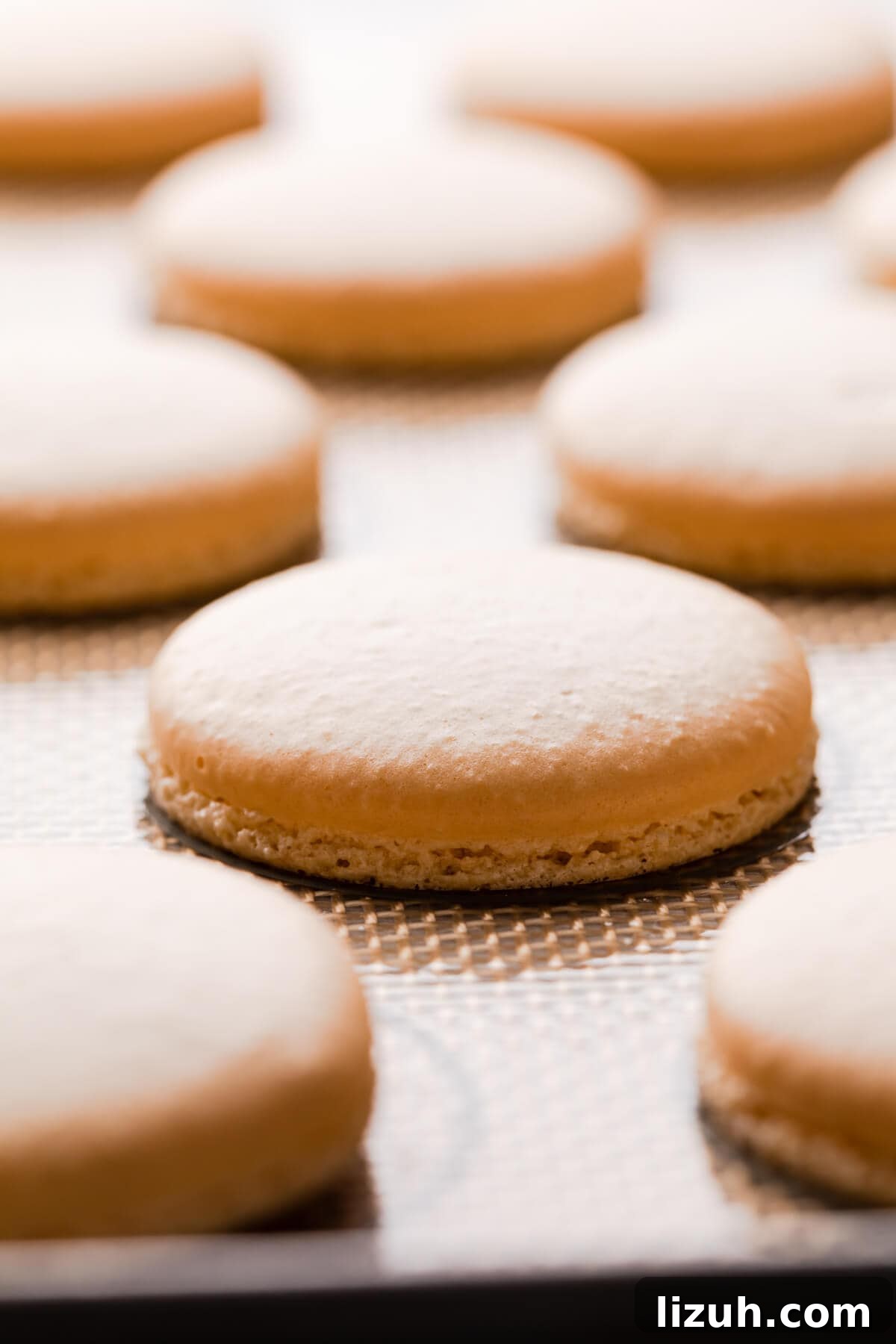
Bake at about 150°C (fan) for 10–15 minutes, one tray at a time, rotating halfway through. The shells should develop feet and be set — if they wobble, bake a little longer.
Tip: It’s better to slightly under-mix than over-mix. The batter should fold into itself and settle within about 20 seconds—if not, fold a few more times.
How to assemble macarons
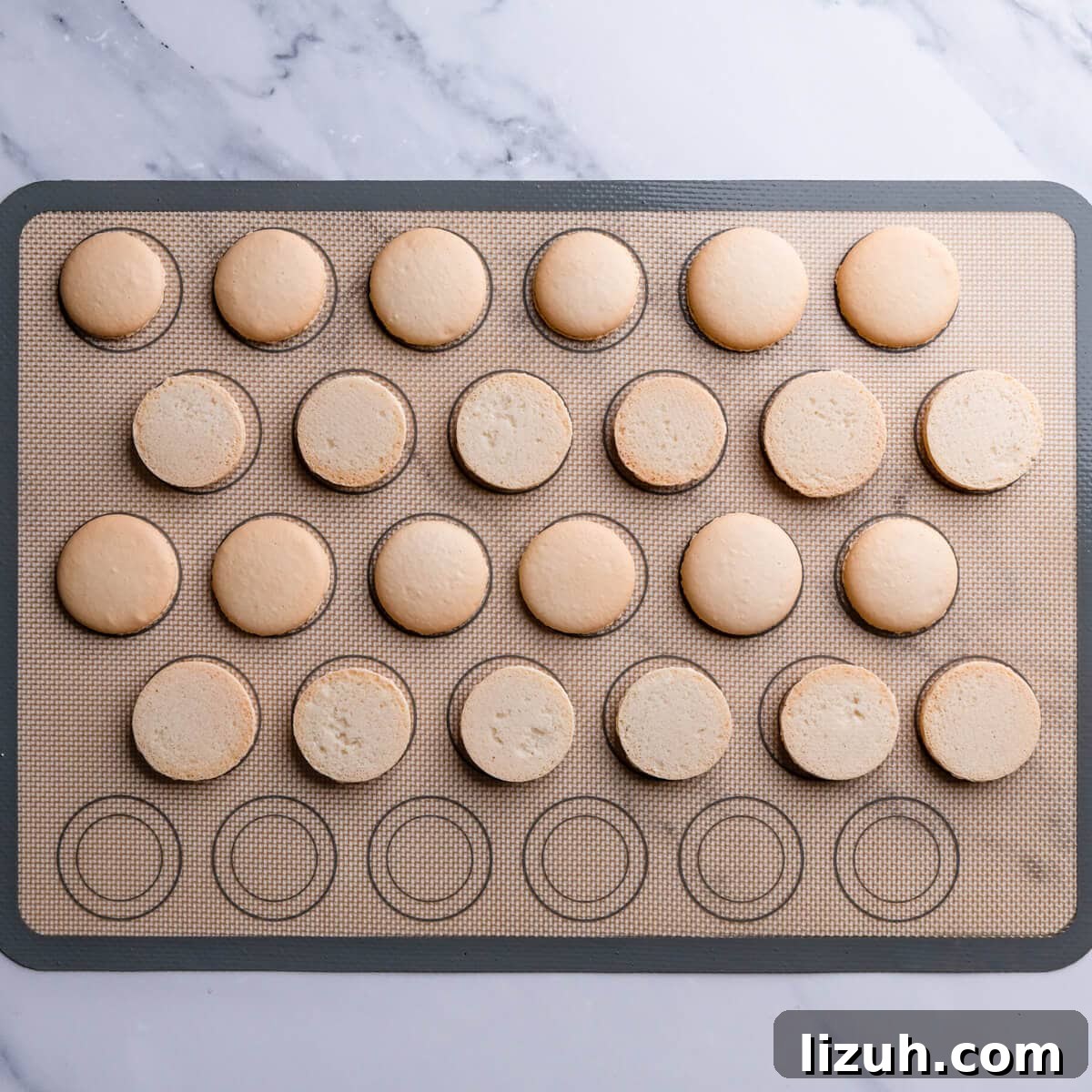
Match shells by size and work gently when removing them from the baking mat. Place one row of shells topside up and one row bottom-side up.
Drizzle melted chocolate and caramel over the tops and sprinkle with sea salt flakes.
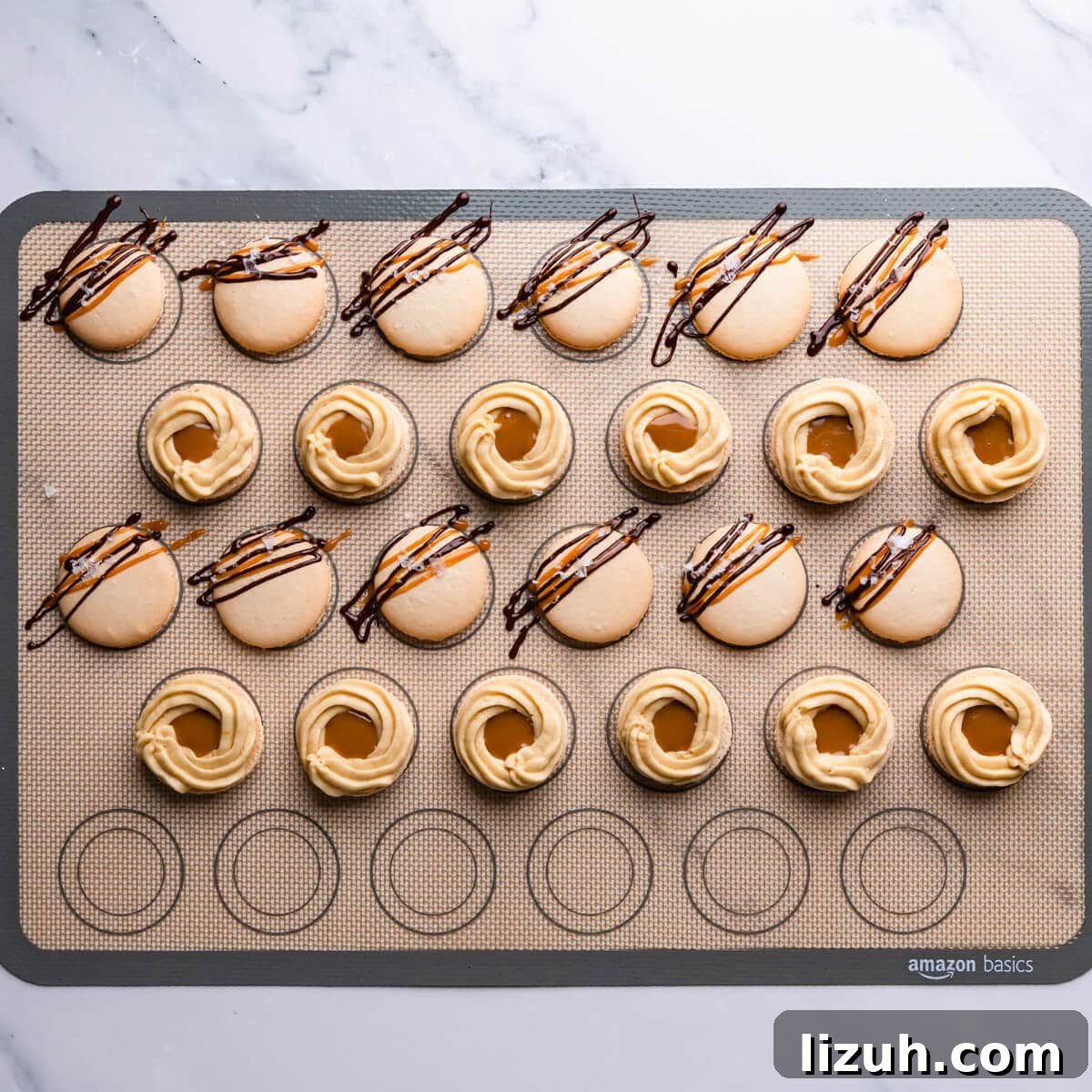
Pipe a ring of buttercream on each bottom shell, fill the center with salted caramel, then sandwich with the top shell. Press gently to close.
Hint: Refrigerate the assembled macarons overnight for the best texture and flavor. Bring them back to room temperature before serving.
Substitutions
Macarons rely on precise measurements and technique, but a few substitutions work well:
- Sugar: Superfine caster sugar is ideal, but regular granulated can be used.
- Almonds: If using coarser ground almonds, sift twice to remove larger particles.
- Egg whites: Fresh egg whites are preferred; carton whites can work but may give a less stable meringue.
- Filling: Swap the Swiss meringue buttercream for a simple buttercream or chocolate ganache. For a quick buttercream, beat 100 g softened unsalted butter with 150 g powdered sugar and 60 g salted caramel until creamy.
- Salted caramel: Ready-made salted caramel or canned dulce de leche both work well.
Variations
- Food colouring: Use gel colours sparingly so batter consistency isn’t affected.
- Eggless: Eggless macaron recipes exist if you need an alternative.
- Different fillings: Try chocolate ganache, raspberry buttercream, or lemon curd for varied flavors.
- Add-ons: Nuts, sprinkles, or jams can customise the filling and decoration.
Equipment
Essential tools:
- Digital kitchen scales — for accurate measurements.
- Baking trays — several large sheets for multiple batches.
- Parchment paper or silicone mats — mats with macaron templates are helpful.
- Piping bag and plain round nozzle — to pipe the shells.
For the Swiss meringue buttercream and decorations:
- Stand mixer with whisk and paddle attachments speeds up the process.
- Kitchen thermometer — helpful when heating the egg-sugar mixture for SMB.
- Extra piping bags — one for buttercream, one for caramel, one for melted chocolate.
Storage
Store assembled macarons in an airtight container in the fridge for up to 7 days. Serve at room temperature.
Freeze assembled macarons or shells for up to 2 months in a container layered with parchment paper to prevent sticking. Thaw at room temperature before serving.
You can make components ahead: shells a day or two in advance, and buttercream will keep up to 3 days in the fridge (re-whip if needed). Salted caramel can be refrigerated or frozen; buttercream can be frozen for up to 3 months, then thawed and re-whipped.

Top tip
Three stages determine success: the meringue, the folding, and drying the shells. Master these and you’ll consistently produce beautiful macarons.
- Meringue: Use a clean, grease-free bowl and whip to stiff peaks that stand upright.
- Folding: Aim for a glossy batter that flows in ribbons; avoid over- or under-mixing.
- Drying: Allow shells to dry until they form a skin; depending on humidity this may take 30 minutes to several hours, but it’s worth the wait.
FAQ
Cracked shells are usually caused by an oven that’s too hot, an over-whipped meringue that trapped air, or batter inconsistencies. Use an oven thermometer and test small batches to find the right temperature, stop whipping at stiff peaks, and fold the batter to the correct consistency.
Lack of feet often means the batter was too wet or the shells didn’t dry enough before baking. Allow adequate drying time to form a proper skin before baking.
If the egg whites weren’t whipped properly, or if the meringue lost volume during folding, macarons won’t rise. Also ensure the oven temperature is sufficient so air bubbles can expand and lift the shells.
Pin this recipe using the recipe card or the photos above to save it for later.
If you try this recipe, please rate it and leave a comment—feedback helps other bakers and I love hearing from you.
📖 Recipe

Salted Caramel Macarons
Equipment
- Digital kitchen scales
- Baking trays
- Parchment paper or silicone baking mats
- Piping bags and plain round nozzle
- Stand mixer (recommended) and kitchen thermometer (optional)
Ingredients
For the macaron shells:
- 110 g egg whites (about 3 large), room temperature
- 110 g caster or granulated sugar
- 115 g almond flour or ground almonds
- 115 g icing (powdered) sugar
For the salted caramel Swiss meringue buttercream:
- 2 large egg whites
- 100 g caster or granulated sugar
- 140 g unsalted butter, softened but cool, cut into cubes
- 60 g salted caramel (homemade or shop-bought)
- 1 tsp vanilla extract
- ½ tsp salt
For decorating:
- 50 g dark or milk chocolate, melted
- 50 g salted caramel
- 1 tbsp sea salt flakes
Instructions
To make the macaron shells:
- Line baking trays with parchment or silicone mats with templates.
- Sift almond flour and icing sugar together; discard any large particles.
- Whisk egg whites to soft peaks, add sugar gradually and beat to stiff peaks.
- Fold the dry mix into the meringue in two additions until the batter is glossy and flows in ribbons (figure-8 test).
- Pipe rounds about 2.5 cm in diameter onto prepared trays. Tap to release air bubbles and pop visible bubbles with a toothpick.
- Let the shells dry until they form a skin, 1–2 hours (may vary with humidity).
- Preheat oven to 150°C (fan). Bake one tray at a time for 10–15 minutes, rotating halfway, until feet form and shells are set.
- Cool completely before gently removing from the mat or parchment.
To make the salted caramel Swiss buttercream:
- Whisk sugar into egg whites and place over a pan of simmering water, whisking constantly until the sugar dissolves and the mixture reaches 71°C or feels smooth when rubbed between fingers.
- Transfer to a stand mixer and whisk until glossy and cool to the touch (may take up to 20 minutes).
- Beat in butter gradually, a little at a time, until thick and smooth. Chill briefly if it separates, then re-whip.
- Add salted caramel, vanilla, and salt; mix to combine and transfer to a piping bag.
To assemble:
- Match shells by size. Drizzle melted chocolate and caramel over the tops and sprinkle with sea salt.
- Pipe a ring of buttercream on each bottom shell and fill the center with salted caramel. Sandwich with top shells and press gently.
- Refrigerate overnight for best flavor development or serve immediately at room temperature.
Note: The recipe is developed and tested in metric grams. Use digital scales for best results. Metric-to-US conversions are provided but may not be tested as precisely.
Notes
- Oven temperature: Temperatures vary—150°C fan works well for many ovens; test small batches to find your oven’s ideal setting.
- Bake one tray at a time and rotate halfway through for even baking.
- Adjust baking time by macaron size—smaller rounds bake faster; larger shells need more time.
- Test doneness: Shells should feel set and not wobble when gently touched.
- Cool completely before peeling shells off parchment or mats to avoid tearing.
Storage
Store macarons in an airtight container in the fridge up to 7 days. Freeze assembled macarons or shells for up to 2 months; thaw at room temperature before serving.
Nutrition
Per serving (approx.): 120 kcal. Nutrition values vary based on ingredients and portion size.
If you try the recipe, please leave a comment or share a photo. I love seeing your results!