Because summers in Japan are hot and humid, Japanese cooks have perfected a number of light, refreshing dishes suited to sultry weather.
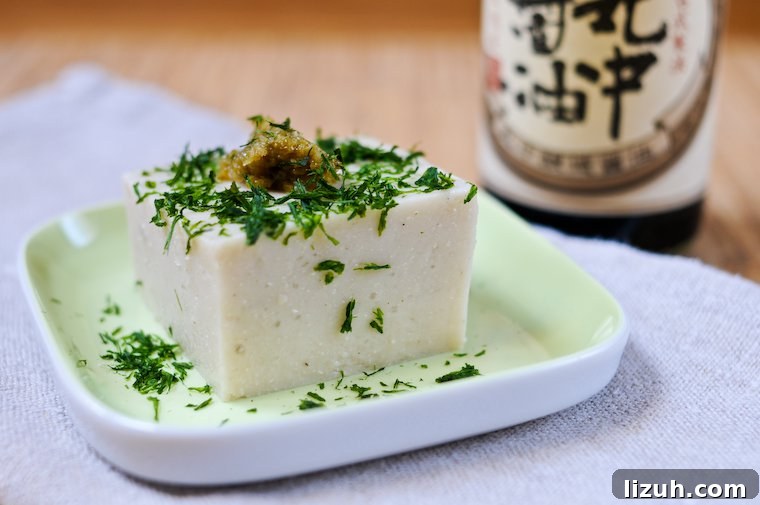
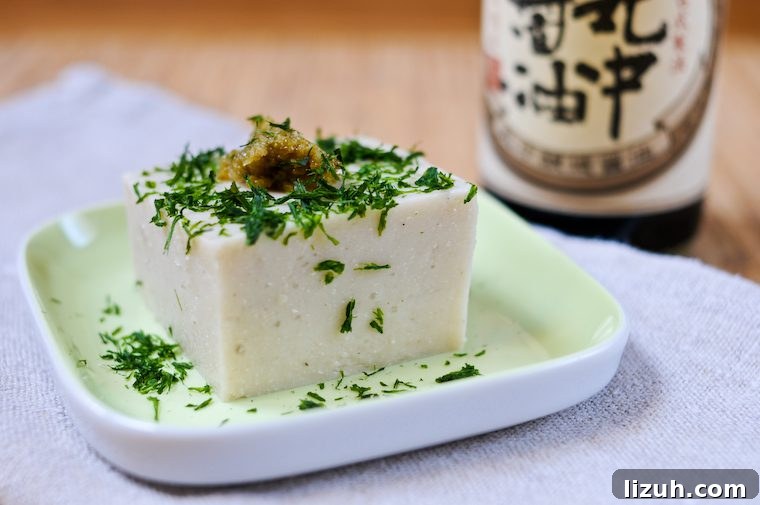
Gomadofu is one such dish: a silky preparation of sesame paste cooked with a starch until it sets. It resembles tofu in color and texture—hence the name (goma = sesame)—and is traditionally served chilled.
I first discovered gomadofu when Maxence and I stayed overnight at a temple in Koya-san during a trip to Japan last spring. At the temple we were served a shojin ryori dinner, the vegan cuisine associated with Zen Buddhist monks, and one of the small courses was a shallow cup of gomadofu—silky on the tongue and deeply flavorful.
I hadn’t thought to make it at home until I found a clear recipe on Maki’s helpful Japanese food blog. The method looked simple enough that I had to try it.
I already had sesame paste on hand—a Middle Eastern tahini from my local organic store—so the only specialty ingredient I needed was kudzu powder, a starch obtained from the kudzu vine. Kudzu powder is often available at natural foods stores or Japanese markets under names like kuzuko.
My first attempt, following Maki’s approach, was a delicious success. The process is straightforward: mix sesame paste, kudzu starch, and water; heat until the mixture thickens; then chill to set.
On a later batch I borrowed a couple of optional tips from another good Japanese food blog. I steeped a piece of kombu (seaweed) in the water beforehand to add a subtle umami, and added a splash of sake for a touch of depth. Both steps are optional but add a pleasant complexity.
Making gomadofu requires little effort. Once set, you unmold it, cut it into cubes, and serve chilled as an appetizer or as part of a light meal. It is commonly paired with soy sauce, wasabi, and freshly grated ginger, or with a simple homemade sauce.
I enjoy mine with a dab of yuzukosho (a yuzu-and-pepper condiment) and a little seaweed—either torn nori or, as pictured, a sprinkle of freshwater seaweed—alongside soy sauce.
After perfecting the classic sesame version, I’m planning to try variations using almond butter (amondodofu) and cashew butter (kashudofu) for different flavors.
For further reading, look up posts by Maki and Tess; they both offer useful background and tips on making gomadofu.
* If you’d like to learn more about shojin ryori, Maki recommends a book called The Enlightened Kitchen by Mari Fujii.
** Names for the nut-butter versions are informal inventions of my own.

Have you tried this? Share your pics on Instagram!
Please tag your pictures with #cnzrecipes. I’ll share my favorites!
Prep Time: 30 minutes
Cook Time: 25 minutes
Total Time: 4 hours, 55 minutes
Serves 8 to 12.
Ingredients
- 500 ml (1/2 quart) filtered or spring water
- A 5-cm (2-inch) piece of kombu (optional)
- 50 grams (1 3/4 ounces) kudzu starch (look for it in natural food stores or Japanese markets, possibly under the name kuzuko)
- 70 grams (2 1/2 ounces, about 1/3 cup) white sesame paste (you can use a Middle-Eastern tahini or a Japanese neri-goma, whichever is easier to find)
- 1 tablespoon sake (optional)
Instructions
- Put the water and kombu (if using) in a bowl and let them sit for at least 1 hour. Remove the kombu and discard, or reserve for another use.
- Place the kudzu starch in a medium mixing bowl. Add a little of the kombu-infused water and stir or mash until completely smooth. Add the sesame paste, then pour in the remaining water gradually, stirring well so the mixture thins without forming lumps. Use a whisk if desired, but avoid incorporating air; the mixture should not become frothy.
- Pour the mixture into a medium saucepan and add the sake if using.
- Place the pan over medium heat and stir constantly with a spatula as the mixture thickens. When it begins to form lumps, reduce the heat to low and continue cooking for 10 to 15 minutes, stirring continuously, until the texture becomes pudding-like.
- Wet the inside of a square or rectangular container (about 750 ml / 3 cups capacity) so the gomadofu unmolds easily. Pour in the thickened mixture, smooth the surface, and refrigerate to set for 2 to 3 hours.
- Unmold onto a plate and cut into squares, dipping the knife blade in hot water between cuts for clean slices.
https://cnz.to/recipes/starters/gomadofu-sesame-tofu-recipe/